
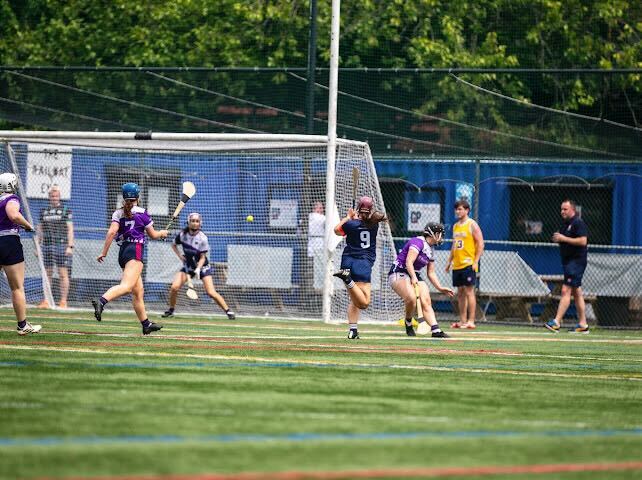
Camogie is a distinctly Irish stick-and-ball field sport for women that grew out of ancient hurling traditions and a 20th‑century drive to promote Irish language, culture, and women’s sport. Ancient roots and early stick‑and‑ball games.
References to hurling‑type games in Ireland go back many centuries, with women also known to play forms of the game alongside men in rural communities. These early versions were not yet called Camogie, but they laid the cultural and sporting foundation: ash sticks, a small ball, and a fast, physical contest played across open fields.
As Irish cultural nationalism strengthened in the late 19th century, traditional games like hurling became symbols of identity, and this environment created the conditions for a codified women’s game to emerge.
The birth of Camogie (1903–1905)
The word Camogie comes from the Irish camógaíocht, derived from camóg, a shorter hurley used by women, in contrast to the men’s camán used in hurling. In 1903, scholar Tadhg Ó Donnchadha (Tórna) helped coin and standardise the name at meetings preparing for the first organised matches.
On 17 July 1904, Camogie had its official public launch with a match between Craobh a’ Cheithnigh and Cúchulainn at a Gaelic League fair in County Meath, often cited as the sport’s founding game. The following year, 1905, the governing body Cumann Camógaíochta na nGael (The Camogie Association) was established, with Máire Ní Chinnéide elected as its first president and Cáit Ní Dhonnchadha among the key founders, reflecting its strong roots in the Irish‑language movement and women’s activism.
Organising the game: early competitions and structures
After foundation, the new Association focused on standardising rules, promoting clubs, and building competition structures for schools, colleges, and counties.
Milestones came quickly:
- 1912: The first inter‑county match took place between Dublin and Louth at Jones’s Road (the site of modern Croke Park).
- 1913: The first college Camogie club was formed in University College Dublin by Professor Úna Ní Fhaircheallaigh, embedding the game in student life.
- 1915: The Ashbourne Cup, an inter‑varsity competition that remains the oldest Camogie tournament, was inaugurated.
By the early 1930s, Camogie had spread widely, with organised play in all 32 counties of Ireland, a remarkable expansion from its modest urban and cultural‑movement beginnings.
The All‑Ireland era and the O’Duffy Cup
The first All‑Ireland Senior Camogie Championship began in 1932, 28 years after the sport’s launch and the establishment of its Association. Ten counties entered this inaugural championship, which was run on an open draw format and ultimately won by Dublin.
Mayo man Seán O’Duffy donated the silver trophy for the new competition; in his honour, the All‑Ireland senior cup is known as the O’Duffy Cup, the most prestigious prize in the Camogie calendar. During these early decades, players typically wore knee‑length gym frocks, long dark stockings, canvas boots, and long‑sleeved blouses with a sash, an outfit very different from modern skorts and jerseys but emblematic of women’s sport of the period. Growth, challenges, and international spread
Cork and Dublin dominated many of the early championships, building strong club and county structures that set standards for coaching and playing style. However, the Camogie Association experienced internal disputes in the 1940s, which led to periods when traditional powerhouses like Dublin and Cork did not participate, allowing counties such as Antrim to claim multiple titles in succession.
Camogie also crossed the Atlantic early: by 1930 an American Camogie Association was in existence, reflecting the game’s popularity among Irish emigrant communities. Over time, clubs and teams formed across Britain, North America, and later other parts of Europe and Australasia, often attached to Irish cultural or GAA clubs. Modern Camogie: governance, identity, and participation
The Camogie Association, long officially known as Cumann Camógaíochta na nGael, was reconstituted several times (notably in 1911, 1923, and 1939) as it adjusted its structures and relationship with the GAA. In 2010, the Association adopted the shorter English name “The Camogie Association,” signalling a modernised brand while still centring Irish language and heritage.
Today, Camogie is played by approximately 100,000 women and girls in Ireland and worldwide, making it one of the leading female team sports connected to the Gaelic games family. The sport remains almost identical in play to hurling as they play on the same pitch, similar equipment, and comparable speed. However, Camogie maintains its own rules, competitions, and strong female‑led administrative tradition. If you are interested in playing Camogie in New York, get in touch!